


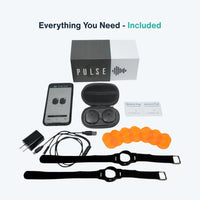
Supporting foot awareness, heel contact, and intentional walking through targeted vibration.
1. Who Is This Routine For?
This routine is designed for individuals who frequently walk on their toes and are working toward greater foot awareness, heel contact, and more intentional walking patterns.
It may be particularly useful to explore for individuals who:
-
Frequently walk on their toes but can comfortably place their heels on the ground.
-
Have difficulty maintaining awareness of their foot position while walking.
-
Are practicing heel-to-toe walking with a physical or occupational therapist.
-
Want to incorporate additional sensory feedback into their movement routines.
How Pulse Fits In
Pulse uses targeted mechanical vibration to stimulate sensory receptors in the skin and underlying tissues, providing additional sensory input to the nervous system.
When paired with intentional movement, this feedback may help support awareness of foot positioning and provide an additional sensory cue during heel-contact and walking exercises.
The goal: Incorporate sensory feedback into activities that encourage foot awareness and controlled heel-to-toe walking.
Pulse is not a treatment for toe walking, and its ability to correct walking patterns has not been clinically established.
2. Where to Place Your Pulse Devices
Primary Placement: Back of Both Ankles
Position one Pulse Device on the back of each ankle, just above the heel, near the Achilles tendon region, following the placement demonstrated by the pediatric therapist.
Placement instructions:
-
Locate the back of the ankle, immediately above the heel.
-
Position one Pulse Device comfortably in this region on each leg.
-
Secure the devices without restricting ankle movement or circulation.
-
Check that both devices remain comfortable during movement.
Why this placement?
The posterior ankle provides an opportunity to introduce localized sensory feedback near the heel during walking practice.
This may help individuals pay greater attention to foot positioning and heel contact as they perform intentional movements.
The exact position relative to the Achilles tendon should be confirmed with the treating therapist. Avoid uncomfortable pressure over the tendon, prominent bones, or irritated skin.
Watch Pulse in Action: Sensory Feedback for Toe Walking
See an example of how a pediatric therapist incorporates Pulse into walking practice.
In this demonstration, Pulse Devices are positioned near the back of both ankles while a child practices walking.
The video illustrates how targeted vibration can be incorporated into movement activities focused on foot awareness and heel contact.
https://www.instagram.com/p/DefV_qlRZc7/
Note: This video demonstrates one practitioner's approach. Individual experiences and results may vary, and the footage does not establish that Pulse corrects toe walking.
3. Recommended Pulse Settings
Option 1: Sensory Feedback & Awareness
App setting: Rehab → Sensory Feedback & Tissue Health → Indirect
Placement: Back of both ankles.
This setting can be explored when the goal is to provide additional sensory input during foot-awareness and heel-contact exercises.
Begin with a low, comfortable intensity that provides noticeable vibration without pain, distress, or interference with movement.
Option 2: Movement-Focused Feedback
App setting: Performance → Select Target Muscle
Alternative placement: Tibialis anterior muscle on the front-outside portion of the shin.
This option may be explored with a therapist during exercises involving active ankle dorsiflexion, or lifting the toes toward the shin.
Getting Started: For children, device settings, intensity, and duration should be determined with their treating clinician. The suggested settings are starting points for discussion, not a clinically validated toe-walking protocol.
4. Exercises to Try
Exercise 1: Heel Awareness & Weight Shifting
Goal: Practice awareness of heel contact and controlled weight distribution.
-
Stand on a stable, flat surface with appropriate adult supervision and support available.
-
Position Pulse on the back of both ankles and activate the selected comfortable setting.
-
Place both feet flat on the ground.
-
Gently shift weight backward toward the heels while maintaining balance.
-
Return to a comfortable standing position.
-
Repeat slowly, taking breaks as needed.
Focus: Notice the sensation of the heels contacting the floor while receiving sensory feedback around the ankles.
Make It Fun: Turn this into a gentle rocking activity, encouraging the child to explore shifting their weight while keeping their feet comfortably grounded.
Exercise 2: Seated Toe Lifts
Goal: Practice controlled ankle movement while maintaining heel contact.
-
Sit comfortably in a supportive chair with both feet on the floor.
-
Keep Pulse positioned on the back of both ankles.
-
Maintain heel contact with the ground.
-
Slowly lift the toes and front of the feet upward.
-
Lower them with control.
-
Repeat for a few comfortable repetitions, resting as needed.
Focus: Pay attention to the movement of the ankles and the sensory feedback provided by Pulse.
Exercise 3: Heel-to-Toe Walking Practice
Goal: Practice intentional heel contact and controlled foot placement during walking.
-
Choose a short, clear walking path on a flat, non-slip surface.
-
With appropriate supervision or support, position Pulse on the back of both ankles.
-
Activate the selected comfortable setting.
-
Begin walking slowly, encouraging gentle heel contact at the beginning of each step.
-
Allow the foot to roll forward naturally toward the toes.
-
Continue for a short, comfortable distance, taking breaks as needed.
Focus: Pay attention to foot positioning and the transition from heel contact to the rest of the foot.
Make It Fun: Place colorful footprints along the walking path and encourage the child to follow them.
Never force heel contact or ankle movement beyond a comfortable range.
5. Tips for Getting the Most Out of This Routine
-
Prioritize comfort: The vibration should feel comfortable and should not increase pain, distress, or involuntary muscle tightening.
-
Focus on sensory awareness: Encourage attention to the feet and ankles during movement.
-
Start simple: Begin with seated and supported activities before progressing to walking.
-
Make it engaging: Short, playful exercises may help children participate comfortably.
-
Follow professional guidance: A physical or occupational therapist can help determine appropriate placements, settings, exercises, and progression.
-
Monitor skin and balance: Check the skin beneath the devices, especially when sensation is reduced, and stop if vibration appears to worsen balance or walking.
Important Safety Information
Pulse is a general wellness device and is not intended to diagnose, treat, or cure toe walking or an underlying neurological or musculoskeletal condition.
Toe walking can have multiple causes, including restricted ankle mobility and neurological or developmental differences. Children who consistently walk on their toes should receive an appropriate professional evaluation.
This routine should be used only with appropriate clinician approval and adult supervision. Do not force heel contact if ankle movement is restricted or painful.
Feel Better. Move Better. With Pulse.
