


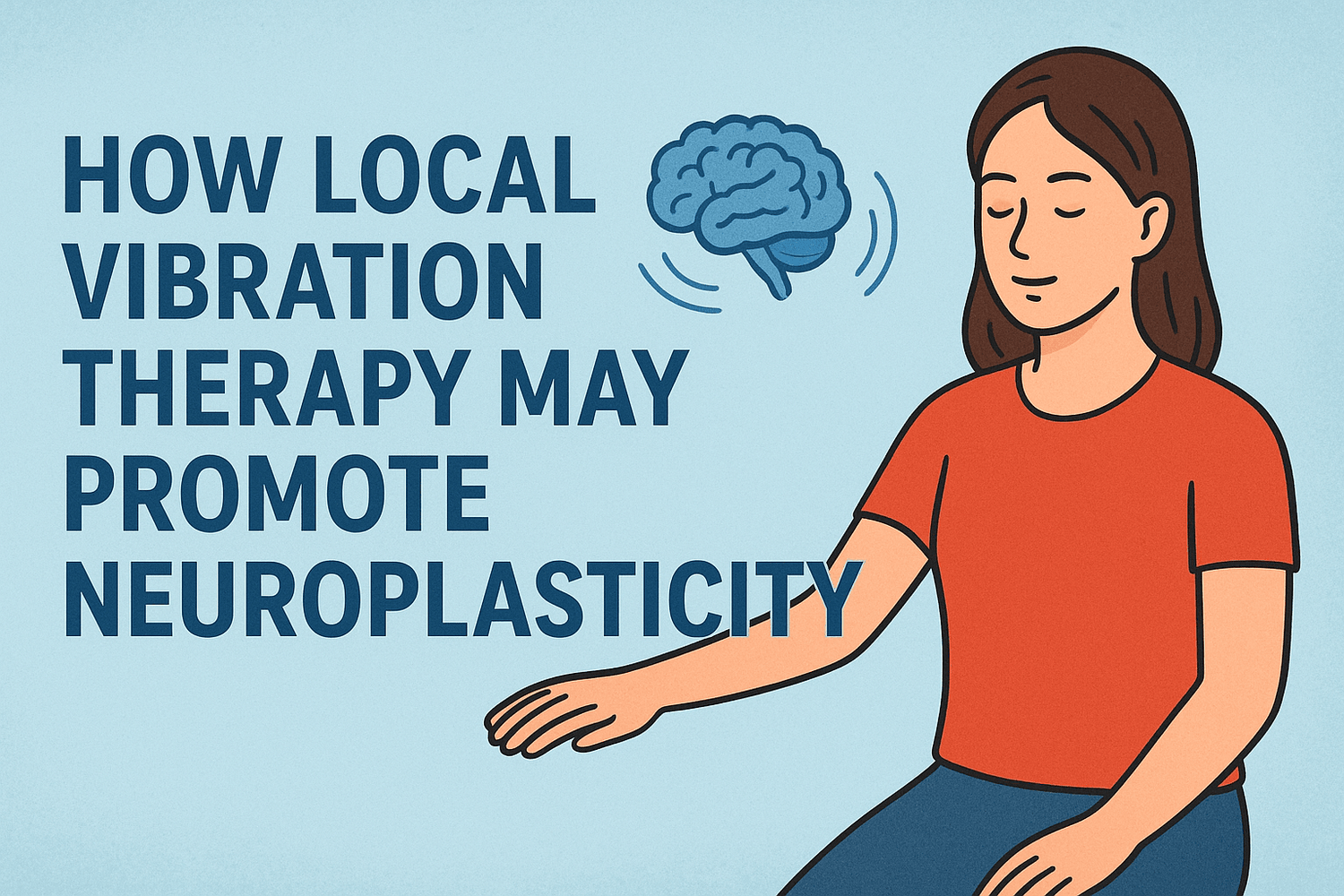
Neuroplasticity—the brain and nervous system’s ability to reorganize connections and adapt—is the foundation of progress for people living with neurological conditions. Whether it’s Parkinson’s disease, multiple sclerosis, spinal cord injury, cerebral palsy, or stroke, promoting adaptive plasticity is key to regaining function, improving strength, and enhancing quality of life.
Recent research suggests that local vibration therapy (vibrotactile or muscle vibration) can act as a powerful tool to encourage these adaptive changes, especially when paired with physical activity or rehabilitation.
Why vibration can drive plastic changes
-
Enhanced sensory input to the brain
Vibration stimulates specialized receptors in the skin and muscles, sending rhythmic sensory signals to the brain. This can reorganize sensory and motor maps—one of the core mechanisms of neuroplasticity Jenkins & Merzenich, 1990. -
Priming motor circuits for learning
Delivering peripheral stimulation, such as vibration, can temporarily increase corticomotor excitability and make the brain more receptive to training. When combined with movement practice, this pairing reinforces new neural pathways Bao et al., 2024. -
Molecular and systemic effects
Vibration training has been linked to increased levels of brain-derived neurotrophic factor (BDNF), a molecule essential for synaptic growth and long-term learning Simão et al., 2019. This provides a biochemical explanation for why repeated exposure can support long-term plasticity.
Evidence across neuro populations
-
Parkinson’s disease: Coordinated vibrotactile stimulation has been shown to reduce abnormal brain rhythms and improve motor control, pointing to durable network-level reorganization Ahn et al., 2019.
-
Stroke recovery: Local vibration applied to muscles or skin has been found to alter cortical excitability and improve movement patterns, reinforcing task-specific neuroplasticity Marconi et al., 2011.
-
Spasticity management: Cutaneous vibration can reduce hypertonia and create a temporary “window” of normalized muscle activity, giving patients a chance to practice movements with better control Seim et al., 2023.
-
General wellness and mobility: Wearable vibrotactile devices allow for frequent, home-based use, which aligns with the principle that high-repetition, task-specific practice drives the strongest neuroplastic gains Seo et al., 2024.
Practical takeaways
-
Best when paired with activity: Vibration is most effective when combined with movement or therapy, rather than used passively.
-
Consistent, tolerable use matters: Daily or repeated sessions support gradual rewiring of neural circuits.
-
Customizable approach: Frequency, intensity, and location of vibration may be tailored depending on goals (motor activation, spasticity relief, sensory priming).
 $0 Today
 Evaluate for 14 Days
 Keep or Return
